Sepia Afternoon
It must have been around four in the afternoon.
Sao Paulo was rotting beneath the rain.
The sky held that uncertain color somewhere between a sickly gray and the brown of soot, as though the whole city had been drowned in a bucket of dirty water and then hung out to dry without hope. Everything looked worn, saturated, old. The afternoon was not falling; it was decaying.
The man stood waiting for the bus at the stop, motionless like someone no longer expecting transportation so much as the end of something more intimate and less nameable. He only wanted to go home.
He was forty-four, perhaps a little older, and he carried in his body the discreet devastation of those who have survived too many years of office hours, deadlines, spreadsheets, and hollow words spoken in closed rooms lit by cruel fluorescent lamps. He was exhausted in a deep, unheroic way. His weariness was not merely physical; it was moral. You could see it in his unsteady gait, in the way he leaned against the wall, in the almost sleepwalking indifference with which he surrendered his own weight to the concrete.
Then he felt a tug at his overcoat.
He turned with a start, still half-drowned in his stupor, and had to narrow his eyes before he could make out the face of the old gypsy woman. She was nearly eighty, wrapped in rags from a hundred seasons, as though she carried on her body every winter that had ever passed over her. Her face was a surface defeated by time; her mouth, a ruin of missing teeth and darkened remnants. There was something in her that seemed irreparably spoiled. Even so - or perhaps because of it - the man could not look away from her eyes.
And there was the child.
The old woman cradled a small bundle wrapped in worn blankets, held tightly against her chest with a dark kind of intimacy, as if she were not carrying it, but keeping vigil over it.
Then she opened her mouth.
The breath that came out of her carried the obscene smell of spoiled flesh, of cold storage, of matter surrendered to its own decomposition. And in a hoarse, breathless voice, almost damp in its sound, she said:
"Could you spare some change so I can feed my daughter?" she said, struggling for breath, as if every word had to climb up from some rotten well inside her. "She is starving to death."
The sentence struck him before he could even understand it. The man took two steps back, overcome at once by fear and revulsion. The old woman was not intimidated. She came closer again, insistent, like certain kinds of misery that refuse to be denied.
"Please, sir."
He jerked his arm free of her touch and answered no, loudly and clearly, with the dry brutality of someone more afraid than defiant.
Then something happened that, later, he would try to recall in a hundred different ways without ever managing to translate it exactly.
The old woman lowered her eyelids, and a narrow, malicious smile gathered at the corner of her mouth, almost satisfied - not a human smile, but the brief twitch of something that had known the outcome from the beginning. Then, in a low, intimate, impossible tone, she called him by name.
That tore him out of his dazed state; it was like waking inside one dream only to fall into a worse one. And before he could react, she threw the child into his arms.
Instinctively, he caught it and dropped to his knees to soften the impact. He closed his eyes for a moment. When he opened them again and rose to his feet, the woman was gone.
She was not walking away. She was not running. She was not hiding.
She had simply vanished.
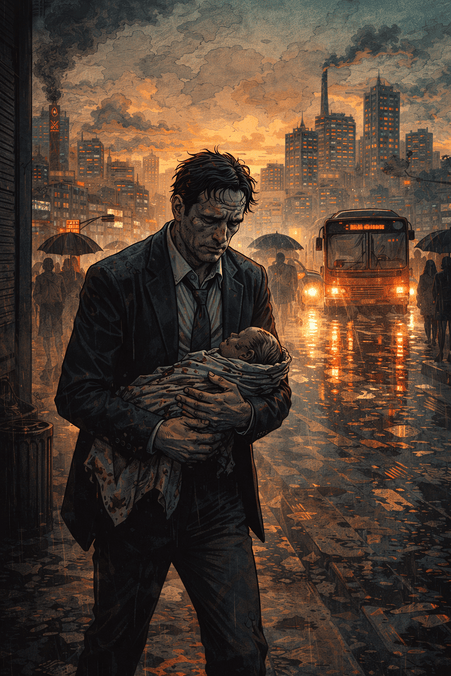
She dissolved among the people, among umbrellas and haste and smoke, as though the city had swallowed her back into itself. But the most terrible thing was not her disappearance. It was realizing that no one seemed to have seen what happened. No one turned around. No one showed surprise. No one offered help. Either everyone was blind, or the world had decided, in that exact instant, to leave him alone.
With his heart racing and a sticky feeling of unreality covering his skin, he lifted the blanket that hid the little girl's face, wanting only to make sure she was alive, that there had been some mistake, that some scrap of logic still remained inside that filthy afternoon.
Then the smell came.
No longer the old woman's breath, but something thicker, truer, more final: the odor of a morgue, of a sealed body, of flesh beginning to give way under the irreversible action of time.
The child was dead.
Not newly dead.
Dead long enough for decomposition, still discreet, to have already begun its patient work.
The man felt terror rise through his body like a fever. He stood frozen, holding that small corpse in his arms while the world around him went on with its monstrously indifferent routine. He wanted to think. He could not. Inside him, ideas were no longer sentences but spasms. Everything that had happened up to that point felt too excessive to be processed. The exhaustion, the shock, the disgust, the rain, the city, the old woman, the name spoken by the wrong mouth - it all dissolved into an unbearable fog.
Somewhere in his mind a vile, immediate thought appeared, almost natural: he could leave the little girl right there in some corner of the street and walk away.
But the horror of that possibility paralyzed him. Fear would not let him carry it out. Adrenaline tore him away from the spot before consciousness could organize anything. When the first bus pulled up, he got on.
He climbed aboard still wet, carrying the wrapped corpse, and sat beside a woman who looked about sixty-seven. She was well dressed and heavily made up, as if her face had been built in layers over something older and less presentable. Her glasses reflected his image, and there he saw his own face, distorted by the lenses: exhausted, bloodless, in a state of pure terror.
The woman proved talkative from the first moment.
There was in her insistence an intrusive intimacy, almost obscene, as though she could smell vulnerability. She spoke without waiting for him to answer, leaned closer without permission, filled the space around him with a sticky presence. When she noticed the blanket-wrapped bundle in his arms, she assumed there was a child inside. Then she began a sort of game - a grotesque attempt to play with what, to her, was still a baby, but to him had already become dead weight, material proof that reality could split open without warning.
The smell spread through the bus.
At first faint, then clearer, as if the air itself were beginning to fall ill.
The man felt his soul being overtaken by a panic with no exit. And the woman went on talking, smiling, leaning in, giving him no peace, as if she wanted to force him to remain fully conscious inside his own torment.
Then, above all that discomfort, the loudspeaker announced that the next stop would be Se.
The information fell over him with the solemnity of a blessing.
The woman straightened her back, turned to him with a sharper interest, and asked: "This is my stop. Are you coming?"
Needing an excuse to get off the bus - to escape the smell, the closeness, the possibility of being discovered with that body in his arms - he got off with her.
The rain went on, thin and dirty. The interaction continued in the street, uncomfortable and unbroken, until the woman mentioned that she lived ahead in a small townhouse down an alley and was heading that way. Stunned, the man followed her.
He was no longer thinking clearly. In truth, he was barely thinking at all. His mind seemed taken over by a bottomless fatigue, and all he did was move from one point to another like a man being guided by someone else's force. The alley was narrow, damp, poorly lit. There, the city seemed to have retreated by several centuries.
That was when he felt hands on his thighs.
He looked up and saw a wrinkled mouth drowned in red lipstick coming toward his own.
He did not react.
Or he could not.
Or there was no longer, inside him, any part left whole enough to resist.
And then, there between shadow and rain, they began those games of love which, in any other circumstance, might have been merely sordid, perhaps even faintly pleasurable. But there everything took on another nature. There was no desire, only collapse. Sex was less a meeting of bodies than a vertigo, a kind of surrender without will, a degraded flight into matter.
Sex, rain, pollution, and the corpse.
That was all that existed in the world.
With a kiss that felt more like a blow, the woman stepped away and left him behind.
He remained there for a few moments, breathless and hollow, as though he had just come through a fever. And when he recovered the smallest fragment of lucidity, he realized what he had done without realizing it: the small corpse had already been lying inside the alley's trash bin for several minutes.
He had abandoned it there.
Not in a deliberate act, but in one of those holes in consciousness where horror, once it exceeds a certain measure, begins to manage itself.
Then the body reacted before the mind.
As if a bomb had exploded in his chest, he ran out of the alley and crossed the last three blocks to his home with the disoriented violence of the hunted. He went into the building, climbed the stairs gasping, nearly stumbling over his own feet, and unlocked the apartment door with trembling fingers.
Inside, he dropped into the old brown armchair in the living room, his hands on his head, trying to contain inside his skull whatever in him might still remain whole.
Then he saw her.
Standing in the kitchen doorway, his wife watched him with a motionless, deep sadness, dry-eyed. There was something irreparable in that expression, as if she were already mourning an event that had not yet taken place.
Fearful, almost childlike in his ruin, he asked: "What is it?"
She let out a long sigh, a sigh that seemed to rise not from her lungs but from some dark chamber where fatal news is kept. And she answered: "I am pregnant."
Pablo Murad, 03/01/2026